NEED A SATURDAY APPOINTMENT?
We are Open on Saturdays. (Consultations & surgery offered)
Call us today to book your appointment!
We are Open on Saturdays. (Consultations & surgery offered)
Call us today to book your appointment!
 Mon - Fri: 8:00AM - 5:00PM
Many women in Quebec and throughout the country struggle for years—sometimes decades; before receiving a proper diagnosis. What feels like “stubborn fat” or unexplained leg pain is often lipedema, a chronic, progressive condition that affects an estimated 1 in 9 women.
What is Lipedema? ipedema is a chronic medical disorder characterized by the abnormal, symmetrical accumulation of painful adipose (fat) tissue, primarily in the legs, hips, buttocks, and sometimes the arms. Unlike ordinary body fat, lipedema fat is resistant to diet and exercise, causes significant pain and tenderness, and often leads to easy bruising and a heavy, swollen feeling in the affected areas.
Despite its prevalence, lipedema remains under-diagnosed in Canada and worldwide. Many patients tell us they’ve been dismissed as having “obesity” or told to “just lose weight,” only to discover that their disproportionate lower-body shape and pain have a medical cause unrelated to lifestyle alone.
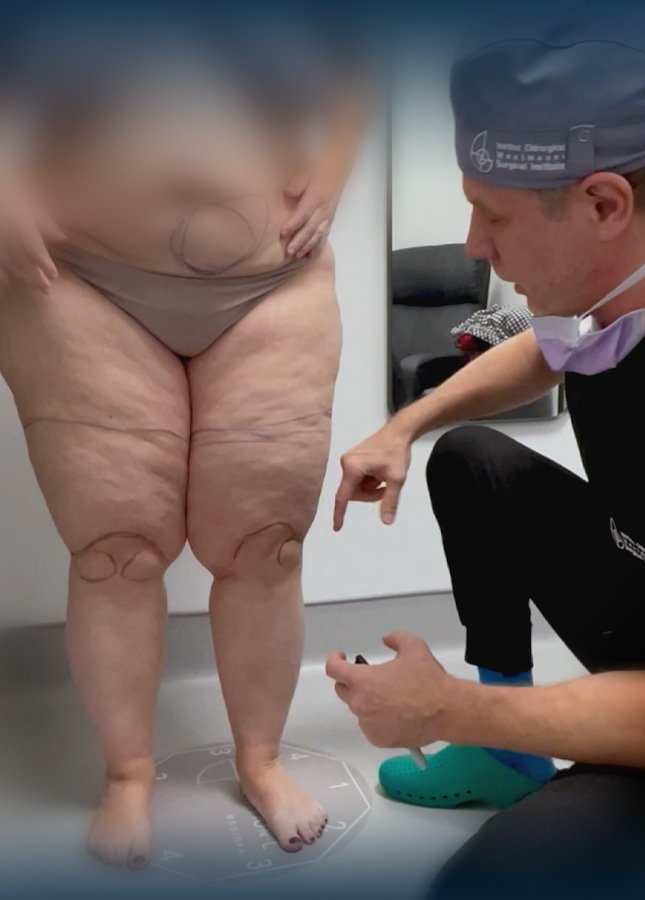
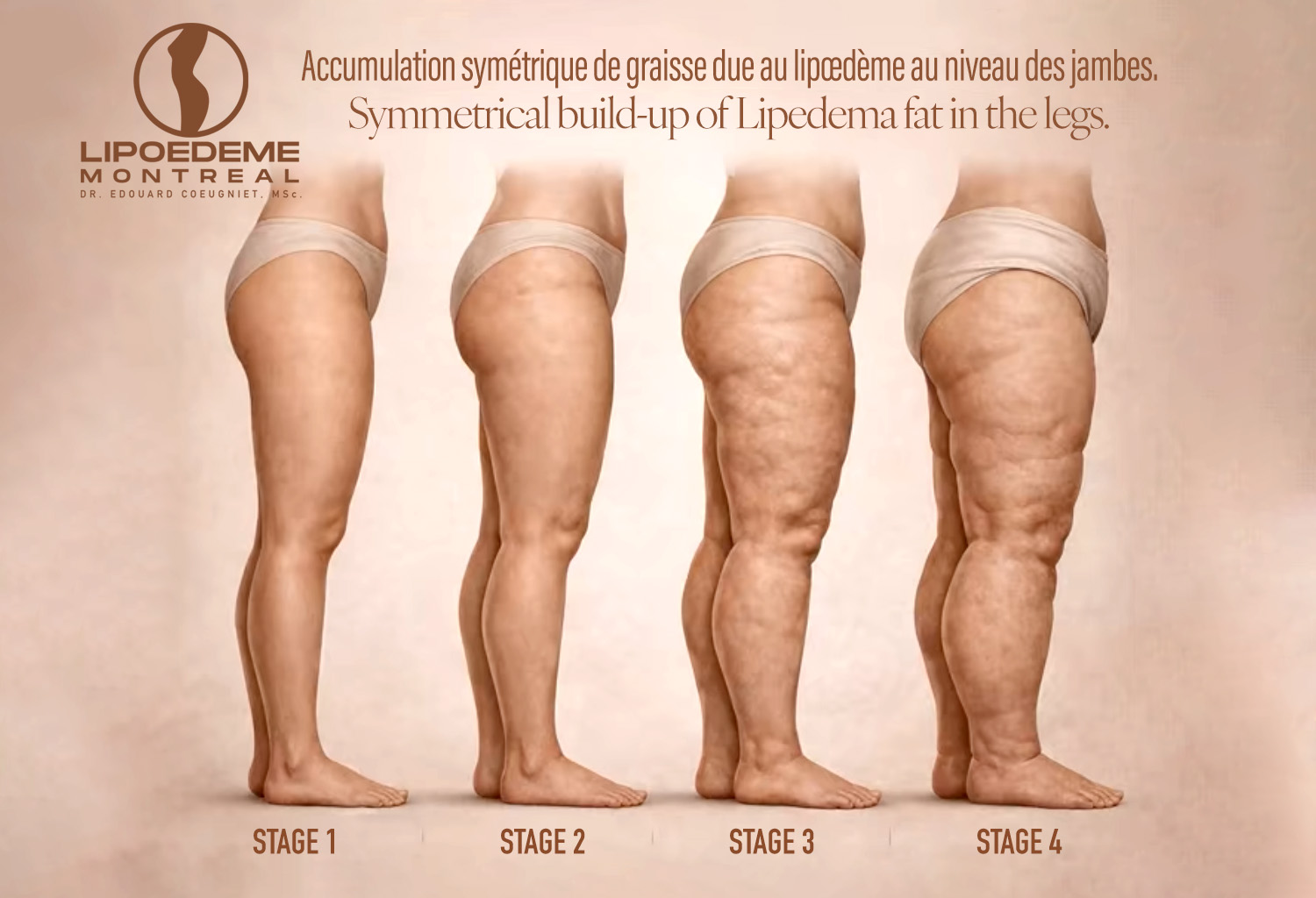
Lipedema is a progressive condition, meaning it changes over time. Dr. Coeugniet and our clinical team categorize Lipedema into four primary stages to determine the best course of treatment.
There is no single blood test or routine imaging (MRI, ultrasound) that definitively diagnoses lipedema—diagnosis is clinical, based on history and physical findings. This is why many general practitioners in Canada miss it.
Living with Lipedema often comes with more than just swelling. It can bring pain, tenderness, and heaviness in the legs, hips, or arms. Some describe it as aching, pressure, or sensitivity that doesn’t go away with typical diet or exercise. At Lipœdème Montréal, we understand how challenging this can be, and we’re here to provide care, relief, and a path toward a more comfortable, active life.
The Canadian climate presents unique challenges. Cold winters can sometimes exacerbate the feeling of heaviness when moving between extreme temperatures, while humid summers can make wearing compression garments difficult.
Because Lipedema involves fat and swelling, it is often misidentified. For patients in Canada seeking an accurate diagnosis, understanding these differences is crucial.
| Feature | Lipedema | Obesity | Lymphedema |
| Symmetry | Always symmetrical | Generally uniform | Usually asymmetrical (one limb) |
| Feet/Hands | Spared (cuffing) | Involved | Involved (swollen) |
| Sensitivity | High tenderness | None | Generally none |
| Diet/Exercise | Resistant | Responsive | Non-responsive |
| Bruising | Easy bruising | Normal | Normal |
Reality: Lipedema fat is fibrotic and metabolically "locked." While a healthy lifestyle is important for overall health, it will not remove Lipedema deposits.
Reality: Cellulitis is a bacterial skin infection. While Lipedema can make the skin look like "cellulite," it is a structural and systemic tissue disorder.
Reality: Surgery for Lipedema is a functional procedure. It is performed to restore the ability to walk without a restricted gait, to reduce tenderness, and to stop the progression of a chronic disease.
Self-diagnosis is often where the journey begins, but a clinical diagnosis from an MSc-level specialist (Backed by elite collaborations with Europe's top pioneers from Germany and Switzerland), like DDr. Edouard Coeugniet, MD, MSc. ensures that you are not overlooking other vascular or metabolic issues.
In Canada, access to Lipedema care can be limited. The Montreal Lipedema Clinic (Lipœdème Montréal) serves as a hub for patients nationwide —across Canada, who are looking for a standard of care that recognizes Lipedema as a legitimate, debilitating medical condition rather than a lifestyle failure.


Lipedema is a chronic disorder that affects almost exclusively women, with rare exceptions. Lipedema bodies come in various shapes and sizes. Lipedema can cause pain and disablement at any size. The classic appearance of lipedema includes bilateral and symmetrical involvement of the lower extremities, with sparing of the feet.
Typically around puberty, but it can also develop or become more pronounced during other hormonal changes, such as pregnancy or menopause. Hormonal birth control may also be a trigger for the onset of lipedema symptoms.
Lipedema is surprisingly common in Canada, estimated to affect up to 1 in 9 women (approximately 11% of females). It is frequently misunderstood or misdiagnosed as obesity, affecting an estimated 2.2 million Canadian women. While the exact cause is unknown, genetics is believed to play a role, as it often runs in families.
Lipedema fat is often painful. People with lipedema report pain with massage, children or pets walking across their laps, or having their blood pressure taken.
The lymphatics are responsible for clearing extra fluid from the tissues. It is important to note that people with lipedema have difficulty clearing a water load from the body, particularly when they remain upright. In addition, imaging of the microscopic lymphatics is abnormal in lipedema patients, and this abnormal pattern is distinct from what is seen in lymphedema.
The exact cause is unknown, but it is believed to be linked to genetics and female hormonal changes, as it often runs in families and starts/worsens during puberty, pregnancy, or menopause.
No, but anti-inflammatory eating helps manage inflammation and prevents worsening.
Extremely rare, but possible; we evaluate all cases individually.
Conservative Treatments: Include specialized compression garments (flat-knit), manual lymphatic drainage (massage), and low-impact exercise (especially in water).
Lipedema Reduction Surgery (Liposuction): Specialized liposuction techniques (like water-assisted or tumescent liposuction) are effective at removing the diseased fat and reducing symptoms.
Often within 1–2 weeks. Contact us at (514) 736-7792 or
info@lipoedememontreal.ca
info@drcoeugniet.com
To learn more about Dr. Edouard Coeugniet, please click link below to visit his website and his credentials:
Lipedema is not your fault, and it doesn’t have to define you. Recognizing the symptoms is empowering—and getting expert help changes everything. At Lipedema Montreal Clinic, we’re here for every woman in Quebec and across Canada searching for answers.
Discover the life-changing relief you've been searching for, right in the heart of Montreal! At Lipœdème Montréal, you're guided by Dr. Edouard Coeugniet, MD, MSc, is a triple board-certified plastic surgeon with over 25 years of unmatched expertise as one of Canada’s foremost authorities on lymph-sparing techniques and restorative Lipedema care. He serves as an Assistant Clinical Professor at the Université de Montréal and holds the critical position of Director of Quality and Performance for Plastic Surgery at the CHUM hospital in Montreal, Quebec (Centre hospitalier de l'Université de Montréal). He's transforming lives with lymphatic-sparing Water-Jet Assisted Liposuction (WAL), the undisputed gold standard that stops lipedema in its tracks and slashes chronic discomfort. Backed by elite collaborations with Europe's top pioneers from Germany and Switzerland. Dr. Coeugniet crafts personalized treatment plans that deliver proven, lasting results—empowering you to embrace freedom and confidence like never before.
BACK TO BLOGState-of-the-art solutions designed to reduce tissue sensitivity and restore your mobility.
 info@lipoedememontreal.ca