NEED A SATURDAY APPOINTMENT?
We are Open on Saturdays. (Consultations & surgery offered)
Call us today to book your appointment!
We are Open on Saturdays. (Consultations & surgery offered)
Call us today to book your appointment!
 Mon - Fri: 8:00AM - 5:00PM
If this sounds familiar, you aren’t "failing" at weight loss. Your body is likely dealing with two entirely different types of tissue.
For many women, this experience isn't a lack of willpower—it’s a biological reality. The truth is that Lipedema tissue is fundamentally different from typical fat. It feels different, behaves differently, and is largely resistant to traditional diet and exercise. Let’s explore the physiological differences between symptomatic adipose tissue and typical fat, so you can gain the clarity and medical validation you deserve.
While normal fat usually responds to diet and exercise, lipedema fat behaves very differently. It is often painful, inflamed, resistant, and accompanied by swelling and heaviness in the legs. This is why lipedema requires a much more comprehensive approach than conventional weight-loss methods.
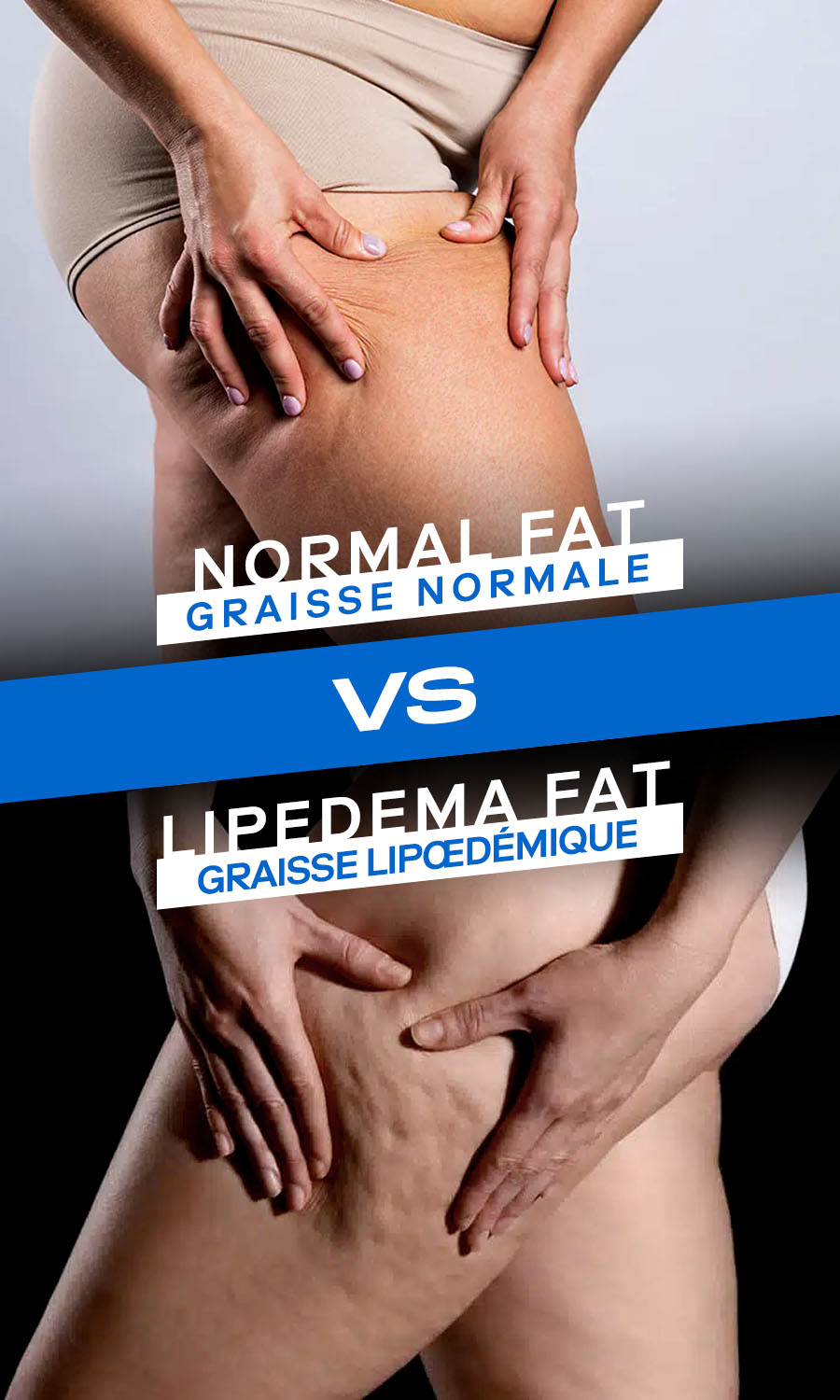
Lipedema fat is not just "extra energy." It is a pathological (diseased) change in the connective tissue and fat cells. In patients with Lipedema, the fat cells undergo hypertrophy (growing in size) and hyperplasia (increasing in number), but they also become trapped in a web of fibrosis (scar-like tissue) and inflammation.
Because this tissue is structurally altered, it is "locked" away from the body's normal metabolic processes. This is why you can be in a starvation state and still have Lipedema deposits on your calves or thighs.
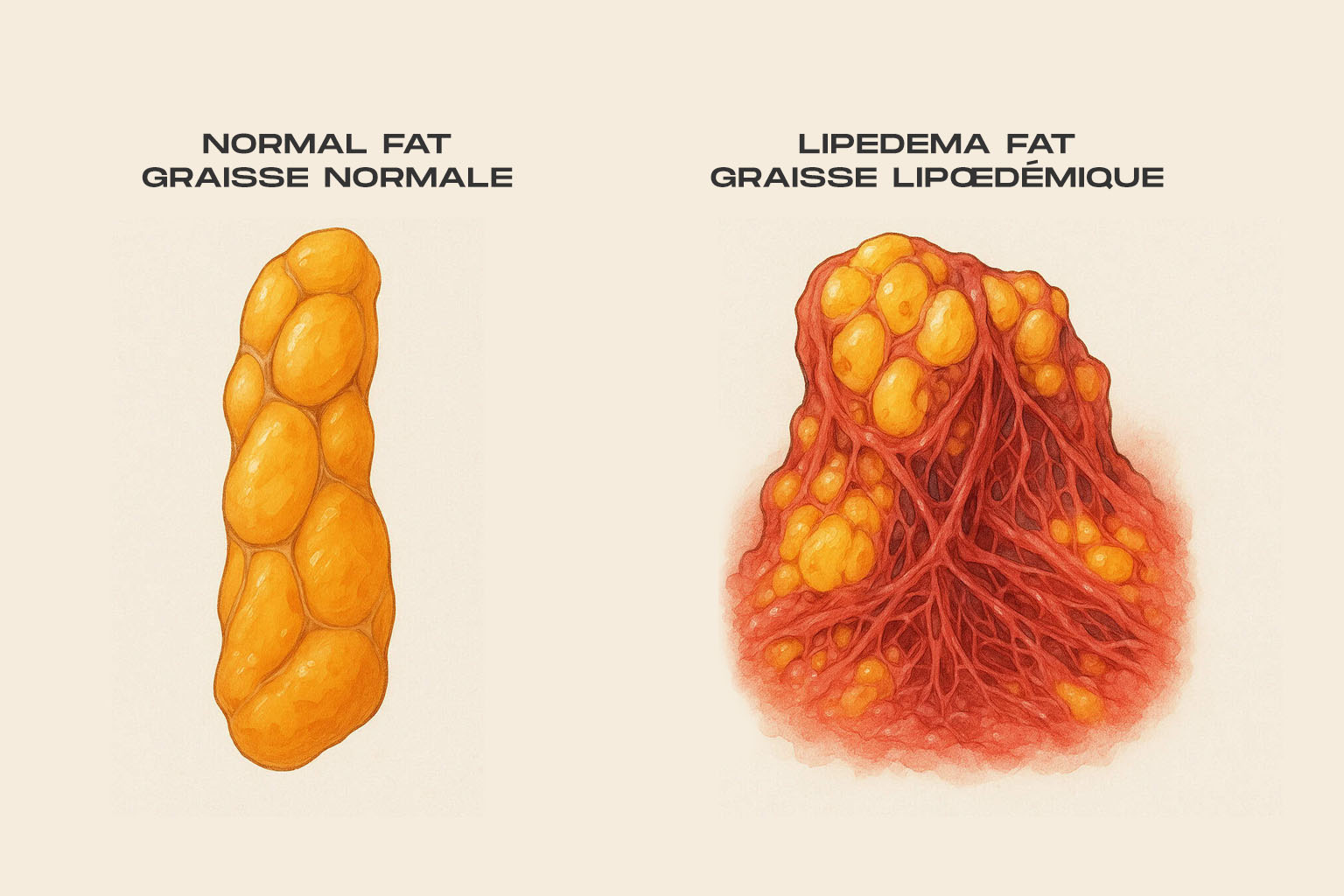
Standard fat is a vital organ. It stores energy, insulates the body, and protects our organs. When we consume more calories than we burn, our body stores the excess in fat cells (adipocytes). When we enter a caloric deficit, the body signals these cells to release that energy.
Crucially, normal fat is distributed according to your genetics—some people carry it in their midsection, others in their hips—but it generally responds proportionally to diet and exercise. If you lose 10% of your body fat, you typically lose it somewhat evenly across your body’s storage sites.
If you are trying to determine if your stubborn fat is Lipedema, look for these four clinical markers:
For those living with Lipedema, the answer lies in the unique structure of the tissue itself. Unlike typical adipose tissue, Lipedema is a progressive disorder characterized by atypical and disproportionate accumulation that ignores the standard rules of metabolism. Understanding these key differences is the first step toward finding a path to relief.
Here is a breakdown of the physiological reasons why this atypical tissue doesn't budge:If you are experiencing tissue sensitivity, easy bruising, or a feeling of heaviness in your limbs that does not improve with traditional weight loss, it is important to consult with a dedicated expert. While conservative therapies like medical-grade compression and manual lymphatic drainage (MLD) are excellent for managing symptoms and supporting the lymphatic system, they rarely address the underlying atypical cells.
Since this symptomatic tissue does not respond to lifestyle changes alone, specialized medical intervention is often the most effective path toward long-term relief. Lymph-sparing techniques, such as Water-Jet Assisted Liposuction (WAL), are designed specifically to bypass the biological barriers of atypical adipose tissue.
By gently dislodging the fibrous, disproportionate cells while meticulously preserving the surrounding lymphatic structures, we can achieve the physical reduction and relief that diet and exercise simply cannot provide. This restorative solution focuses on reclaiming your mobility and comfort, allowing you to move beyond the physical limitations of your diagnosis and rediscover a more harmonized body silhouette.
Once we identify that the tissue is indeed Lipedema, the conversation shifts to how to remove it. Because this fat is fibrotic and resistant to metabolism, surgical intervention is often the most effective path.
Traditional weight loss can shrink a fat cell, but it cannot remove the fibrotic (scar) tissue that develops in Lipedema. Advanced techniques like Water-Assisted Liposuction (WAL) allow us to physically break apart these fibrotic "cages" and remove the diseased cells, something no amount of exercise can achieve.
Lipedema fat produces inflammatory markers that can make you feel fatigued and sluggish. By surgically removing this tissue, we reduce the systemic inflammation in your body. Patients often report that after surgery, they feel a "clarity" and energy boost they haven't felt in years.
When Lipedema fat is left to grow indefinitely, it begins to physically compress the lymphatic vessels. This can lead to a secondary condition called Lipo-Lymphedema. Surgery acts as a preventative measure, "unburdening" the lymphatic system before permanent damage occurs.
When you choose to treat Lipedema surgically with a specialist like Dr. Coeugniet, the benefits are measured in more than just centimeters.
Differentiating between these two types of fat requires a specialized clinical eye. In my practice, we don't just look at the scale; we look at the tissue quality, the lymphatic flow, and the patient's history.
If you have spent years fighting "stubborn fat" that doesn't follow the rules of biology, it’s time for a professional assessment. We use the latest 2026 protocols to ensure that if surgery is the right path for you, it is performed with the highest level of safety and precision.


Yes. This is known as "comorbid obesity." In these cases, we often recommend a weight loss plan to reduce the "normal" fat first, which makes the Lipedema surgery more precise and effective.
No. Once the fat cells have become fibrotic and diseased, they do not revert to normal adipose tissue. They must be managed through conservative therapy or removed surgically.
The inflammatory nature of the tissue weakens the small blood vessels (capillaries) within the fat. Even minor pressure can cause these vessels to leak, leading to frequent bruising.
If you are struggling with the symptoms of Lipedema and want to know more about a safe surgical plan, contact us today.
Discover the life-changing relief you've been searching for, right in the heart of Montreal! At Lipœdème Montréal, you're guided by Dr. Edouard Coeugniet, MD, MSc, is a triple board-certified plastic surgeon with over 25 years of unmatched expertise as one of Canada’s foremost authorities on lymph-sparing techniques and restorative Lipedema care. He serves as an Assistant Clinical Professor at the Université de Montréal and holds the critical position of Director of Quality and Performance for Plastic Surgery at the CHUM hospital in Montreal, Quebec (Centre hospitalier de l'Université de Montréal). He's transforming lives with lymphatic-sparing Water-Jet Assisted Liposuction (WAL), the undisputed gold standard that stops lipedema in its tracks and slashes chronic discomfort. Backed by elite collaborations with Europe's top pioneers from Germany and Switzerland. Dr. Coeugniet crafts personalized treatment plans that deliver proven, lasting results—empowering you to embrace freedom and confidence like never before.
BACK TO BLOGState-of-the-art solutions designed to reduce tissue sensitivity and restore your mobility.
 info@lipoedememontreal.ca